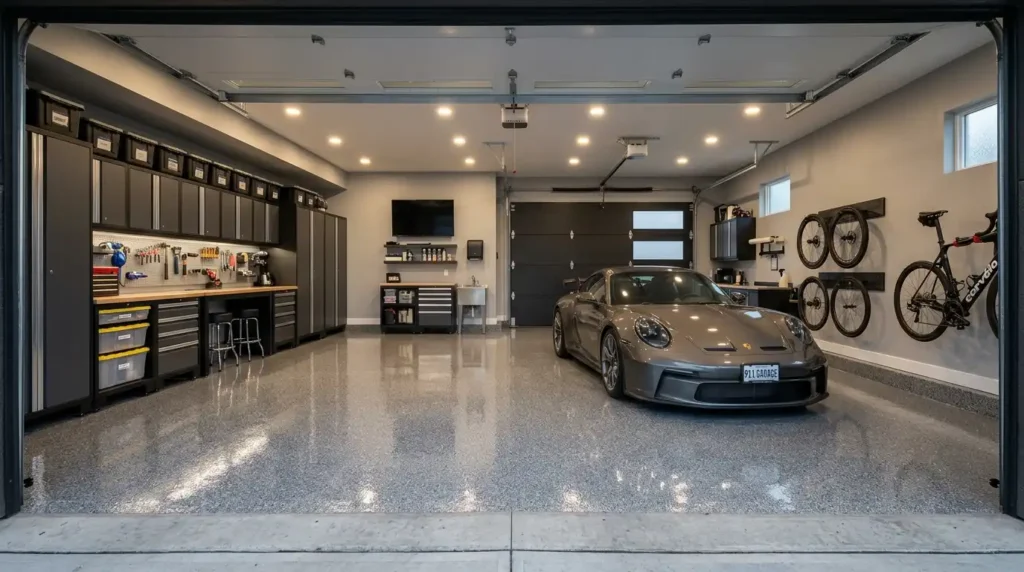
Garages and commercial facilities take a constant beating from heavy vehicle traffic, oil spills, harsh chemicals, extreme temperature swings, and hot tires. Leaving bare concrete exposed leads to dusting, staining, cracking, and eventual structural erosion. To protect concrete surfaces while creating a clean, professional aesthetic, floor coatings are essential. However, choosing between the two industry standards—Epoxy and Polyaspartic coatings—often leaves property owners uncertain about which material delivers the best long-term value.
While traditional epoxy coatings have dominated the market for decades, advanced polyaspartic polyurea technologies have emerged as a superior alternative for both residential garages and high-traffic commercial spaces. Understanding the technical performance, curing times, durability, and cost differences between these two systems is critical to selecting the ideal floor coating for your facility.
What Is Epoxy Concrete Coating?
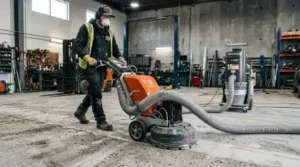
Epoxy is a thermosetting polymer coating formed by mixing a resin base with a hardener catalyst. When combined, a chemical reaction occurs that binds the material directly to properly prepped concrete, creating a hard, thick protective barrier.
Epoxy coatings are widely recognized for their ability to fill minor concrete pits, self-level over uneven surfaces, and provide a high-gloss base coat that accepts decorative color flakes or metallic pigments exceptionally well.
However, traditional epoxy has inherent limitations: it cures slowly, lacks flexibility under thermal expansion, and is susceptible to yellowing or chalking when exposed to ultraviolet (UV) sunlight.
What Is Polyaspartic Coating?
Polyaspartic is an aliphatic polyurea system developed in the 1990s as a protective coating for steel bridge girders and industrial equipment. Modified for concrete floor applications, polyaspartic coatings offer high tensile strength, rapid cure speeds, and exceptional flexibility.
Unlike epoxy, polyaspartic is inherently 100% UV-stable, meaning it will never yellow, chalk, or degrade under direct sunlight. Furthermore, its rapid chemical reaction allows a complete floor system—primer, decorative flake broadcast, and clear topcoat—to be applied and fully cured in a single day.
Head-to-Head Comparison: Polyaspartic vs. Epoxy
Evaluating key performance factors helps determine which material best suits your space’s operational demands:
1. Drying and Curing Times
Time is often the deciding factor for homeowners and business owners alike. Traditional multi-layer epoxy systems require 12 to 24 hours between coats and take up to 3 to 7 days to fully cure before vehicle traffic is permitted. For commercial businesses, extended downtime means lost revenue.
In contrast, polyaspartic coatings feature ultra-fast cure times. A professional crew can complete a multi-layer polyaspartic flake system in 4 to 8 hours. The surface is walkable within 2 to 4 hours and ready for full vehicle parking in just 24 hours.
2. UV Stability and Aesthetic Longevity
Standard epoxy resins break down when exposed to sunlight, causing clear topcoats to turn a cloudy yellow hue over time. If your garage doors remain open frequently or your commercial facility features exterior windows, an epoxy floor will gradually lose its original color integrity.
Polyaspartic topcoats maintain complete clarity regardless of UV exposure, ensuring your decorative flake blend or solid color floor retains its vibrant, high-gloss appearance indefinitely.
3. Hot-Tire Pick-Up Resistance
A common failure in low-grade or traditional epoxy systems is “hot-tire pick-up.” When a vehicle enters a garage after driving, hot rubber tires expand and bond to the cool epoxy resin. As the tires cool and contract, they pull the epoxy coating off the concrete floor, leaving bare patches.
Polyaspartic coatings form a molecular bond with concrete that penetrates deeper into the pores. Combined with superior heat tolerance and elasticity, polyaspartic floors completely eliminate hot-tire peeling.
4. Chemical and Impact Resistance
Both epoxy and polyaspartic systems resist motor oil, gasoline, road salts, brake fluid, and household detergents. However, polyaspartic provides superior scratch and impact resistance due to its flexible molecular structure. According to technical surface testing guidelines published by the Association for Materials Protection and Performance (AMPP), polyurea and polyaspartic formulations exhibit higher abrasion resistance than standard epoxy resins under continuous heavy usage.
5. Temperature Application Flexibility
Epoxy coatings require moderate ambient temperatures—typically between 55°F and 90°F—to cure correctly. Attempting to install epoxy in freezing winter weather leads to chemical curing failures.
Polyaspartic formulations can be professionally applied in extreme temperatures ranging from -30°F up to 140°F, making winter concrete floor installations completely viable.
Why Professional Concrete Preparation Matters
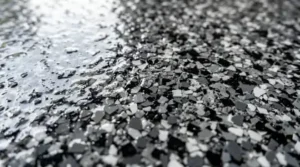
Whether you choose epoxy or polyaspartic, no coating system will adhere to smooth, dirty, or damaged concrete without proper surface prep. Simply acid-washing or pressure-washing a garage floor is insufficient for commercial-grade coating adhesion.
A professional installation requires:
- Mechanical Diamond Grinding: Using heavy industrial grinding machines to remove existing sealers and open the concrete pores to achieve a Concrete Surface Profile (CSP) 2 or 3 standard.
- Concrete Repair: Filling cracks, spalls, and pitted joints with high-strength polyurea joint fillers prior to coating.
- Moisture Mitigation testing: Measuring concrete moisture vapor emission rates (MVER) to prevent hydrostatic pressure from bubbling the floor coating.
Making the Right Choice: Which System Should You Choose?
Choosing the right floor coating depends on your project budget, timeline, and exposure conditions:
- Choose Polyaspartic if: You want a one-day installation, rapid return to service, complete UV non-yellowing protection, maximum scratch resistance, and a lifetime solution for residential garages or active commercial operations.
- Choose Hybrid Epoxy/Polyaspartic if: You have deeply pitted or uneven concrete that requires a thick epoxy build-coat base to smooth out imperfections, combined with a polyaspartic clear topcoat for UV and abrasion protection.
Investing in a high-performance concrete floor coating transforms an ordinary garage or commercial space into a clean, durable, low-maintenance environment that protects your concrete foundation for decades to come.